The Shift within Cloud Security and Privileged Access Management
Cloud Security is experiencing significant transformation as infrastructure, data, and AI systems converge. The traditional boundaries between Cloud Security and Privileged Access Management (PAM) are dissolving.
Previously distinct layers — runtime protection, posture management, and identity access — are now merging into a unified continuum of visibility and enforcement. The 2025 Latio Cloud Security Report reveals that organizations no longer prefer multiple disconnected tools. Instead, they're adopting unified access control and data-flow governance where a single platform monitors and controls how sensitive workloads are accessed by humans, systems, or AI agents.
PAM has re-emerged as the critical enforcement layer for both cloud and on-premises environments. Teams now demand just-in-time access, session-level auditability, and dynamic policy evaluation for every service identity interacting with production data — not just administrators.
Formal operates at this intersection: a cloud-native PAM built for the data era.
Formal's Unique Differentiation: A Centralized PAM Platform
Formal was constructed on a foundational principle: "access control should be as programmable and observable as your infrastructure itself."
Unlike traditional PAM solutions adapted for cloud environments, Formal functions as a centralized enforcement layer unifying human and service access through a protocol-aware platform. The Latio Report recognized this approach as a defining innovation, highlighting its capacity to "deliver visibility, control, and auditability across both cloud and on-prem environments, without sacrificing developer velocity."
Formal integrates:
- Real-time data-flow visualization — tracking information movement across services and access patterns
- Policy-driven workflows — automating rules for requests, approvals, and access enforcement at runtime
- Adaptive enforcement — redacting, aliasing, or blocking sensitive data before transmission
- Protocol aware connectors — supporting databases, APIs, storage systems, SSH, Kubernetes sessions, and AI endpoints
By embedding directly in the data path, Formal transforms access into a measurable control plane rather than a governance checklist.
The New Frontier of Access Isn't Human — It's Agentic
AI systems, copilots, and automation agents increasingly interact with sensitive production data and make security-affecting decisions. The Latio Report identifies this as the "agent access problem," requiring PAM guardrails extended to AI agents in real time.
Formal's architecture governs both human and machine identities, treating AI agents as first-class access model participants. Just-in-time credentials, auditable sessions, and sensitive-data controls apply uniformly to engineers, workloads, and LLMs.
Formal can alias or redact data flowing into AI models, ensuring sensitive content like PII, secrets, or regulated fields remains within approved boundaries. This positions it as the inaugural PAM platform purpose-built for AI governance, bridging infrastructure security and AI oversight.
What This Means for Us
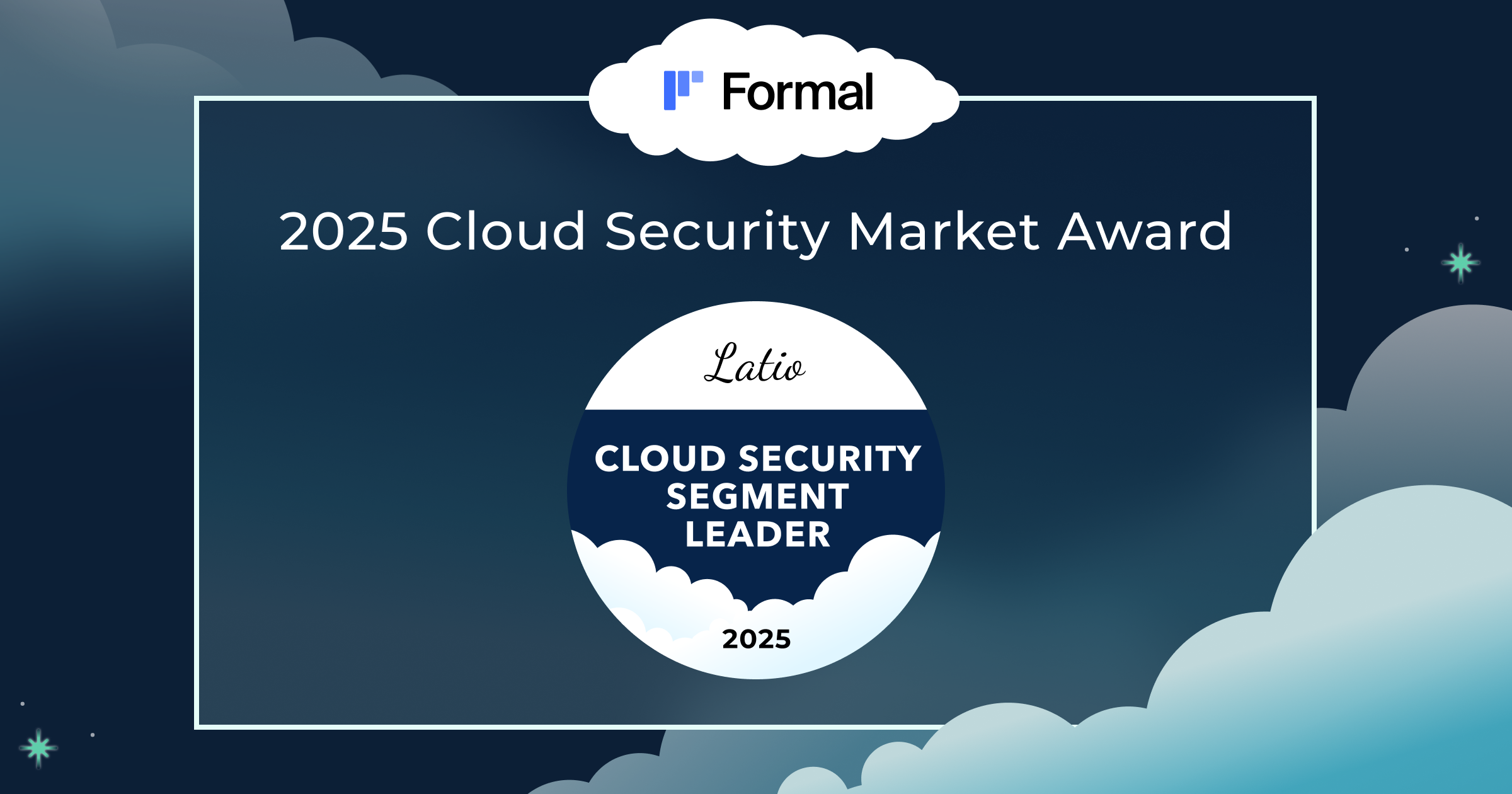
Recognition as a leader in the 2025 Latio Cloud Security Report validates customer understanding: visibility and control belong in a single platform. Security outcomes require no tradeoffs.
Formal's mission delivers a unified enforcement layer for everything accessing sensitive data — human, service, or AI. While cloud security boundaries expand, the principle persists: trust derives from context, not static permissions.
As industry definitions of "access" evolve with automation and AI, Formal continues advancing privileged access management, enabling organizations to move rapidly while maintaining security.